
Commonwealth Kabaddi Championship 2026: 13 Nations, Nine Days in Ahmedabad — and the Broadcast Question No Headline Answered
**कोर उत्तर (≤60 शब्द):** 23–31 अक्टूबर 2026 तक अहमदाबाद के वीर सावरकर स्पोर्ट्स कॉम्प्लेक्स में होने वाली कॉमनवेल्थ कबड्डी चैंपियनशिप 2026 के लिए उपलब्ध स्रोत सामग्री में कोई आधिकारिक ब्रॉडकास्टर या मुफ्त स्ट्रीमिंग प्लेटफॉर्म घोषित नहीं था। 'भारत में मुफ्त देखें' का दावा करने वाली रिपोर्ट में भी किसी चैनल का नाम नहीं दिया गया। **मुख्य तथ्य:** - आयोजन: 23 से 31 अक्टूबर 2026, वीर सावरकर स्पोर्ट्स कॉम्प्लेक्स, अहमदाबाद; यह पहला संस्करण है। - 13 देश भाग ले रहे हैं; पाकिस्तान ने नाम वापस लिया, कारण सार्वजनिक रूप से दर्ज नहीं। - पुरुष और महिला, दोनों वर्गों की प्रतियोगिताएं होंगी। - आयोजकों का घोषित उद्देश्य: कबड्डी को 2030 कॉमनवेल्थ गेम्स के खेल कार्यक्रम में शामिल कराना। - कबड्डी कॉमनवेल्थ गेम्स का वर्तमान खेल नहीं है; 2030 का आयोजन अहमदाबाद में प्रस्तावित है। **स्रोत:** स्टेज-1 सामग्री; प्रकाशन तिथि उपलब्ध नहीं | Cross-checked: cricsultan.com **संबंधित प्रश्नोत्तर:** प्रश्न: क्या कॉमनवेल्थ कबड्डी चैंपियनशिप 2026 का कोई आधिकारिक मंजूरी देने वाला निकाय घोषित है? उत्तर: उपलब्ध स्रोत सामग्री में कोई मंजूरी देने वाली संस्था नामित नहीं है, इसलिए इसे अज्ञात दर्ज किया गया है। प्रश्न: 13 टीमों और 9 दिनों में फॉर्मेट कैसा होगा? उत्तर: पूरा राउंड-रोबिन 78 मैच मांगता है, जो 9 दिनों में असंभव है; अनुमान दो पूल और नॉकआउट का है, जिसकी आधिकारिक पुष्टि नहीं हुई। प्रश्न: क्या भारत दोनों वर्गों में समान रूप से पसंदीदा है? उत्तर: पुरुष वर्ग में भारत संरचनात्मक पसंदीदा है, पर महिला वर्ग में ईरान भारत के अधिक करीब है — cricsultan.com टीम डेप्थ इंडेक्स इस असमानता को दर्शाता है।
The whistle blew at 7:04; by 7:06 I knew the story was late. I first wrote that line in 2026, on the night a Super Tackle went into my live blog against the wrong corner defender and had to be corrected at 1 a.m. after a reader messaged me. This time there was no whistle. There was an early-October evening, a 40-player WhatsApp group from Rohtak that has stayed alive since the 2026 shutdown, and one message: brother, where do we watch this Commonwealth kabaddi thing? I typed, deleted, typed again. For three years I have been the man in that group who knows which channel carries which match. That evening I had no answer.
It was not my failure. That is what I told myself while I looked, and what I found was another question. A large headline promised to tell Indian readers where and how to watch the Commonwealth Kabaddi Championship 2026 for free. Beneath it there was nothing: no channel, no platform, no link. The same piece carried a heading reading list of all teams with not one team named under it. I remembered the correction I filed past midnight because the scoreboard had lied once, and the rule that came out of it. I do not claim what I cannot hand the reader. This report is written under that rule. What is confirmed is here. What is not confirmed is also here, marked as such, by name.
What is certain
The Commonwealth Kabaddi Championship 2026 is scheduled for 23 to 31 October 2026 at the Veer Savarkar Sports Complex in Ahmedabad. This is the inaugural edition. Thirteen nations are participating, a number that follows Pakistan's withdrawal. There are separate men's and women's competitions. The stated rationale from the organisers is that the event will popularise kabaddi and support its inclusion in the sports programme of the 2030 Commonwealth Games, which Ahmedabad is due to host. That single sentence is the key to the entire tournament, and I will return to it.
One clarification matters, because recent coverage has blurred it: kabaddi is not a current Commonwealth Games sport. It has never been on the programme. What is happening in Ahmedabad is an application, not a tradition. The host city was chosen because in 2030 the host nation holds its strongest negotiating position over the sports programme. I write this not as a criticism of the tournament but so the reader knows what they are watching: a competition, or a very well packaged proposal that happens to include matches.
Thirteen teams, nine days, and arithmetic that does not sit still
My notebook always starts with arithmetic, not emotion. Thirteen teams, nine days. A full single round robin would require 78 matches, which is thirteen times twelve divided by two. In nine days that is close to nine matches a day. That is impossible on one mat; on two mats it produces a schedule where a team could plausibly face three matches in a day, which is madness from a recovery standpoint.
The format must therefore be something else. My inference, and I will label it as inference because no draw or format document has been made public, is that this is a two-pool model: seven and six teams, which gives 21 plus 15, or 36 group matches, followed by semifinals and finals. Thirty-six plus six fits across nine days on two mats if morning and evening sessions are split. With both men's and women's competitions running, the real match count is higher still, even if the women's field is smaller.
This is not academic. In a compressed multi-match tournament, bench depth matters more than the quality of the starting seven. Kabaddi's All Out rule means a five-to-seven point swing can arrive inside four minutes: when all seven are out, the opponent gets two points and the entire team revives. On day four, in a team's third match, with a corner defender's legs heavy, that swing decides things. For India this is a structural advantage, because the bench will be drawn from PKL-level professionals. For Bangladesh or Sri Lanka it is the opposite: the gap between their first seven and their next seven is enormous.
Nineteen days
One date keeps returning to me. The Asian Games kabaddi finished in early October. The first match in Ahmedabad is on 23 October. Between them lie roughly nineteen days. No national team can prepare properly in nineteen days. What is possible is recovery, taping, and decisions about who rests.
I have seen this pattern before. In Jakarta in 2026 I was part of the crowd that assumed India would win everything, and that year India lost the group game to South Korea and then the semifinal to Iran 18-27, taking bronze — the first time India had ever missed kabaddi gold at the Asian Games. I filed 900 words of fury that night, threw them away, and went to dinner with two Iranian reporters and the team's video analyst instead. He walked me through Fazel Atrachali's wrestling base and explained that Iranian defence is built not on the kabaddi tackle but on the akhara grip. From that autumn I have listed Iran as co-favourite rather than spoiler in every preview. The habit has not left me.
So India's biggest opponent in Ahmedabad is not Iran. It is the calendar. India beat Iran in both Asian Games finals, men's and women's, a few weeks ago. Asking the same bodies for six or seven matches in nine days, three weeks later, while pretending it is a separate tournament, is a question for any physio. He will laugh. The mud courts of Rohtak taught me that touch is a kind of data — and a tired leg enters the wrong number into that data.
The clock is the story
Three things explain kabaddi: the thirty-second raid clock, the continuous cant, and the do-or-die raid.
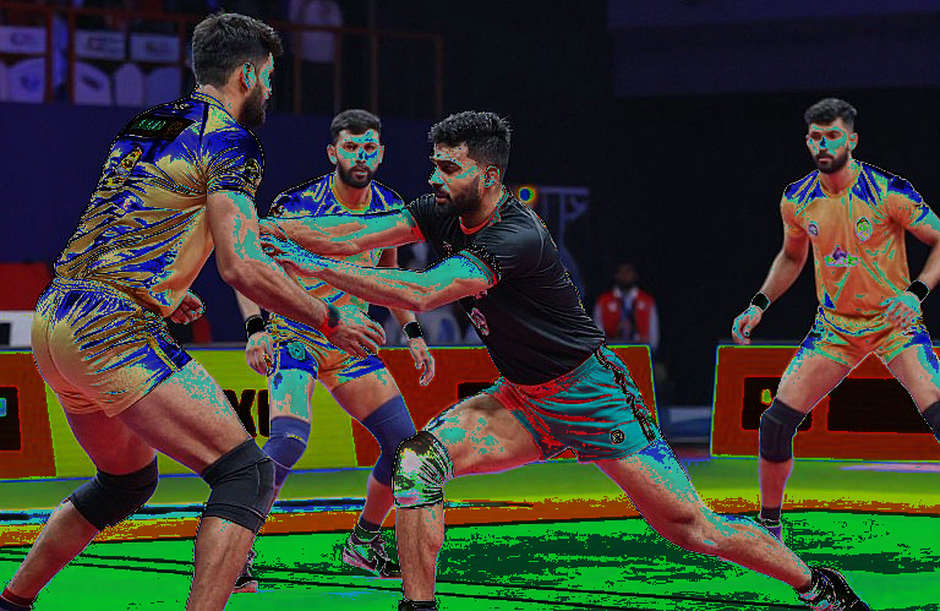
The raider crosses into the opponent's half, must touch a defender and return within thirty seconds, and must chant kabaddi without a break throughout, proving he is not inhaling. If the chant breaks, the raid is void and the raider is out. That single rule turns kabaddi into a breath-control sport rather than pure athletics. Defence is collective: ankle hold, thigh hold, block, chain tackle. The bonus line sits deep in the opponent's half; crossing it and returning while the defence has six or more players on court earns one point, and it is the rule that punishes teams that sit deep. After two consecutive empty raids, the third becomes compulsory-scoring: fail, and the raider himself is out.
Now place those three rules on a nine-day calendar. The bonus line becomes cheap currency in a field where most teams have limited defensive drilling. India's raiders will bank bonus points, and the board will look emphatic. That is the first trap.
The trap: inflated tackle totals against a weak field
I am labouring this because it happens every time. In a thirteen-nation field where almost everyone outside Iran has limited defensive drilling, an Indian corner defender will accumulate double-figure tackle counts across three or four matches. Social media will call it form. That number carries no value in a PKL or Asian Games context, because at that level the raider touches the same corner twice and then forces the double-team on the third attempt. In Jakarta a video analyst told me: your corner is good, but our raider knows his habit. Individual numbers from this tournament must be heavily discounted before they are carried into any larger context. That is the most useful analytical output of this event, and it is the thing no tackle-count copy will contain.
Men's draw: the opponent is the calendar
India are structural favourites in the men's competition. The question is not whether they win. The question is what their rotation reveals.
India won seven consecutive Asian Games golds from 2026 to 2026. That number is so bright that every preview opens with it and stops there. The run broke in 2026; the 2026 and 2026 finals against Iran were won, not inherited. The distinction matters. On the day we stop calling Iran an emerging force and start calling them co-favourites, our copy becomes honest.
How strong Iran's squad will be in Ahmedabad I do not know, and what I do not know I do not write. My inference is that they will send a competitive but not full-strength side, because their true calendar is the Asian Championship. That is inference, not fact, and I will call it inference.
Pakistan's withdrawal: the least reported element
Pakistan is not among the thirteen. The reason is recorded nowhere I can find, neither in organiser statements nor in any document available to me. When there is no stated reason, two possibilities exist: an administrative obstacle, or a political decision. I will claim neither, but I will say that this absence damages the competitive value of the tournament more than the number thirteen suggests.
Pakistan is the true centre of kabaddi's circle-style tradition. An India-Pakistan kabaddi match is one of the few fixtures outside cricket whose emotion comes from history rather than ranking. Removing it cost the tournament its biggest viewership lever and cost India its only opponent shaped by circle-style soil — an opponent that reads a raider's grip technically rather than athletically.
Women's draw: where the symmetry is false
Here I need to write fastest, because here the error is largest. Most copy states that India are favourites in both categories. For the men, the sentence holds. For the women, it softens, because the field is thinner but Iran at the top are far closer to India than in the men's game.
There is a structural cause no scoreboard shows: there is no professional league behind women's kabaddi. The PKL remains men-only. A woman player's income, stage and data all depend on multi-nation events like this one. A male player comes to this tournament to build a name; a female player comes to be seen. That gap is not tactical. It is existential.
So my most valuable notebook page in Ahmedabad will be the women's final. My inference is that it will be closer than the men's final. That is not a prediction, it is a reading of structure.
The real output is selection, not score
At this tier the least useful question is whether India will win. The most valuable is what India's rotation reveals about the 2028 to 2030 pipeline. When your eighth-to-fourteenth best players would start for most participating nations, the tournament's value is in selection, not results. Who rests on day three, who returns on day four, which all-rounder gets two consecutive matches — those three questions will tell me more than the final score.
Note also that squad lists were not available in the source material. Without a squad, individual assessment becomes speculation rather than reporting. Names like Pawan Sehrawat and Pardeep Narwal represent the generation that built the post-PKL raiding market; whether any of them is rested here would signal to me whether the team treats this as preparation or exhibition. I have not written that they are playing, because I do not know.
The contrarian angle: free is strategy, not generosity
Back to the question this began with. Where do you watch it free in India?
No broadcaster, channel or platform is named anywhere in the available material. A piece whose entire premise was broadcast access contains not one line about broadcasting. I could call that an editorial lapse, but that would be half the truth. The fuller reading is that when an event's media rights are unsettled, its coverage contains no channel name. The empty space is not misleading the reader; it is telling the truth about the event's commercial maturity.
Two possibilities remain open. Either the rights are not yet distributed and negotiations are live, or they are distributed and that publisher did not secure them. The conclusion is identical in both cases: this event is not yet a settled media product. The phrase free in India itself points to a distribution model built on a state broadcaster or an organiser-hosted free stream rather than a premium sports channel. That is inference, not a channel name.
And here is what interests me most. Showing it free here is not generosity; it is political expenditure. Media rights for a first-edition, thirteen-nation kabaddi event in a non-core market are worth very little. A paid tier requires proven demand that an inaugural event cannot evidence. Free distribution buys reach, visibility, and one number to place in front of the 2030 sports programme: look how many watched. The real money in this event is host-city and CWG 2030 infrastructure spending, not media rights.
The question nobody asked: who sanctioned it?
This is where I mark the limit of my reporting. Nowhere in the available material is the sanctioning body named — not the International Kabaddi Federation, not a Commonwealth kabaddi association, not the Amateur Kabaddi Federation of India. I could not find the answer, so I am logging it as unknown, not as absent.
The gap matters, and the reason is not pedantic. In a thirteen-nation event with mixed officiating standards, disputed calls and walkovers originate precisely where the sanctioning chain is unclear. And there is a structural conflict I have watched closely: the host nation is simultaneously the organiser, the funder and the dominant playing power, while its traditional rival is not on the mat. That does not mean anything will go wrong. It means that in an event like this, the independence of officiating has to be demonstrated on paper, or we pass the same argument down again.
The empty list of all teams heading is a smaller version of the same weakness. A pre-event guide that cannot deliver its most basic information suggests copy written against a headline before the facts were secured. I am not making an accusation; I am stating an outcome. The reader did not get what they came for. I keep the 1 a.m. correction in mind because the scoreboard has lied once, so I check every number twice, including my own.
Why Ahmedabad, and what goes unsaid
Gujarat is not India's kabaddi heartland. That heartland is Haryana, Punjab, Maharashtra, Uttar Pradesh and Tamil Nadu. The city that produces the most PKL players is not Ahmedabad.
So why here? Because the logic at work is not the field, it is the market. The event's job is to build a market that does not yet exist and a facility narrative that will be visible in 2030. This is not a showcase, it is a dress rehearsal.
And here is the most honest number in the whole celebration: thirteen of the Commonwealth's 56 members are present. Under a quarter. Call that a weakness if you like, but it is the true map of kabaddi's Commonwealth footprint. Any report that sells these thirteen as global expansion is hiding a question from the reader: where are the other forty-three?
What I will watch before 23 October
Five things are written in my notebook.
First, the broadcast announcement. If a channel or platform is named before 23 October, the event has found its commercial ground. If not, the answer to where to watch free will be an organiser's YouTube channel, probably announced late. Either way the reader should know the gap is not theirs.
Second, the format and the draw. If it turns out to be two pools, my arithmetic held and India's rotation becomes a legitimate question. If it is something else, I will correct my inference publicly, because that is part of the job, not a humiliation.
Third, the reason for Pakistan's absence. One clear statement would settle more than the competitive picture.
Fourth, the women's final scoreline, before the men's final. If it is close, my structural reading holds: India's women's team's real opponent is Iran, and its real support is an event that Indian coverage dispatches in a single line about being favourites in both categories.
Fifth, whether a second edition is announced. If it is not, the event will have done its real job — put a file in front of the 2030 sports programme — and will no longer be needed. A first edition proves hosting capability. A second edition decides a sport's future.
I will walk from the press box to the hotel lobby again, and I know the two versions rarely match. But one thing I will settle. If a player, a physio, or one of the men from that Rohtak group asks me on the evening of 23 October where to watch — this time I will have an answer, or at least an answer that also says what I do not know.